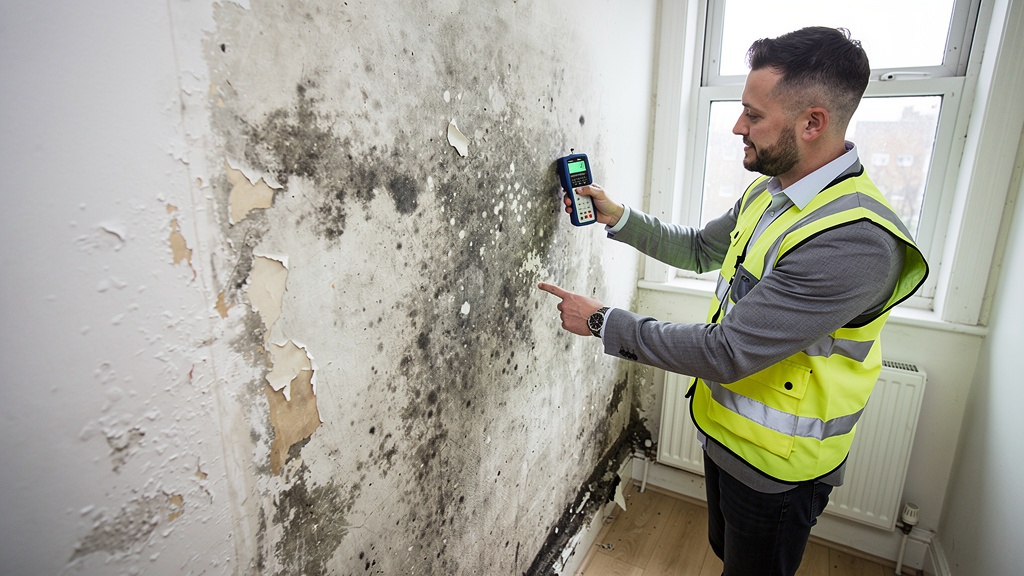
Damp is, without question, the most common issue our building surveyors in Balham encounter. We find it in flats and houses, new-builds and period properties, cheap homes and expensive ones. It's everywhere — and it causes a surprising amount of misunderstanding.
The most important thing to understand about damp is that not all damp is equal. There are three main types, each with different causes, different solutions and different price tags. Misidentifying the type of damp can lead to expensive, ineffective "remediation" treatments that solve nothing.
Type 1: Condensation
Condensation is by far the most common form of damp in London properties. It happens when warm, moist air — produced by cooking, showering, breathing and drying clothes — comes into contact with cold surfaces like walls and windows and loses its moisture as water droplets.
You've seen it on bathroom mirrors. But condensation also occurs on external walls, in corners, and behind furniture — often going unnoticed until mould starts to grow.
Key signs: Black mould growth on walls, ceilings and window frames; generalised dampness that's worse in winter; steamy windows.
The fix: Improved ventilation, better heating, secondary glazing or extractor fans. NOT chemical injection or cavity treatments. Treating condensation as rising damp is one of the most common — and costly — mistakes in the property industry.
Typical cost: £200–£1,500 for ventilation improvements
Type 2: Penetrating Damp
Penetrating damp occurs when water gets in through the building's fabric — through defective pointing, cracked render, failed window seals, defective gutters, or a leaking roof. Unlike condensation, it tends to appear in specific locations rather than spreading generally.
Key signs: Damp patches that appear or worsen during or after rainfall; staining and tide marks; localised mould growth; damaged plaster or decorations.
The fix: Find and repair the source of water ingress. This might be repointing brickwork, replacing failed render, repairing a gutter, or replacing a flashings. Once the source is fixed, the damp will dry out over time.
Typical cost: £300–£5,000 depending on cause and extent
Type 3: Rising Damp
Rising damp is genuine but relatively rare — despite what some damp-proofing contractors will tell you. It occurs when groundwater rises up through masonry due to capillary action, usually where a damp-proof course is absent or has failed.
Key signs: A tide mark on the lower part of a wall (typically no higher than 1 metre above floor level); salt deposits causing white staining; damaged plaster at low level. Crucially, it's generally worse in winter when the water table is higher and better in summer.
The fix: A chemical DPC (damp-proof course) injection, followed by re-plastering with salt-retarding plaster. Important: don't pay for this unless you're sure the diagnosis is correct. A moisture meter reading alone is not sufficient to diagnose rising damp.
Typical cost: £1,000–£4,000 for a chemical DPC
How Do Surveyors Diagnose Damp?
Our surveyors use a combination of visual inspection and moisture meter readings to assess damp. A moisture meter measures electrical resistance in the wall — high moisture = high conductivity = high reading. However, moisture meter readings need to be interpreted carefully in context: salt deposits, metallic pipes and condensation can all give false positive readings.
We also use thermal imaging cameras in some cases, which can reveal patterns of moisture that aren't visible to the naked eye. This is particularly useful for identifying concealed penetrating damp behind plasterboard dry lining.
When in doubt, we recommend specialist investigation — a thorough damp survey by a suitably qualified specialist, ideally one who is independent of any damp treatment company.
Should Damp Stop You Buying a Property?
Not necessarily. Damp is common in London's older housing stock, and most types are fixable at a manageable cost. What matters is:
- Understanding the type and cause of the damp
- Getting realistic cost estimates for remediation
- Using those estimates to renegotiate the purchase price if appropriate
A property with a damp problem that's been correctly diagnosed and priced into the deal can be an excellent buy. A property with a damp problem that you don't know about before exchange can be a very expensive mistake.
The Case of the "Rising Damp" That Wasn't
I want to share a case from my experience at Balham Surveyors that illustrates this perfectly. A client instructed me to carry out a Level 3 building survey on a 1930s semi in Streatham. The vendor had provided a survey from a damp-proofing company that diagnosed rising damp throughout the ground floor and quoted £8,500 for chemical injection treatment.
When I inspected the property, I found that the "damp" was almost entirely caused by condensation — the property had no extractors in the kitchen or bathroom, the heating was poor, and the new conservatory had created a damp microclimate at the back of the house. The one area of genuine damp was caused by a blocked gutter at the rear.
My client used my report to negotiate £6,000 off the price, had the gutter replaced for £200, fitted a mechanical ventilation system for £800, and had no further damp issues. She didn't need any chemical injection at all.
Get a building survey before you exchange contracts. A good surveyor will assess damp levels in all accessible areas and give you a clear picture of any issues. Don't rely on a visual inspection or a survey carried out by a damp treatment company (who have a financial interest in finding damp).
Black mould (Stachybotrys or similar) is almost always caused by condensation. It grows where warm, moist air meets cold surfaces and where there isn't enough ventilation to remove the moisture. It's very common in London properties, particularly in bathrooms, kitchens and north-facing rooms.
It depends on the type of damp and how long it's been there. Penetrating damp can take 6–18 months to fully dry out after the source is fixed, depending on the depth of saturation. Rising damp takes longer still. During the drying-out period, affected plaster should not be re-decorated — it needs to dry first.
If our building survey identifies significant damp that requires further investigation, we'll recommend a specialist damp survey. This should be carried out by an independent specialist — not a damp treatment contractor who will benefit financially from recommending treatment. Ask for a surveyor who is a member of the Property Care Association (PCA) and has no commercial interest in the outcome.
Yes — this is one of the most serious consequences of untreated damp. Sustained damp conditions in timber can lead to wet rot or dry rot, both of which can cause significant structural damage to floors, joists, window frames and roof timbers. This is why identifying and addressing damp early is so important.