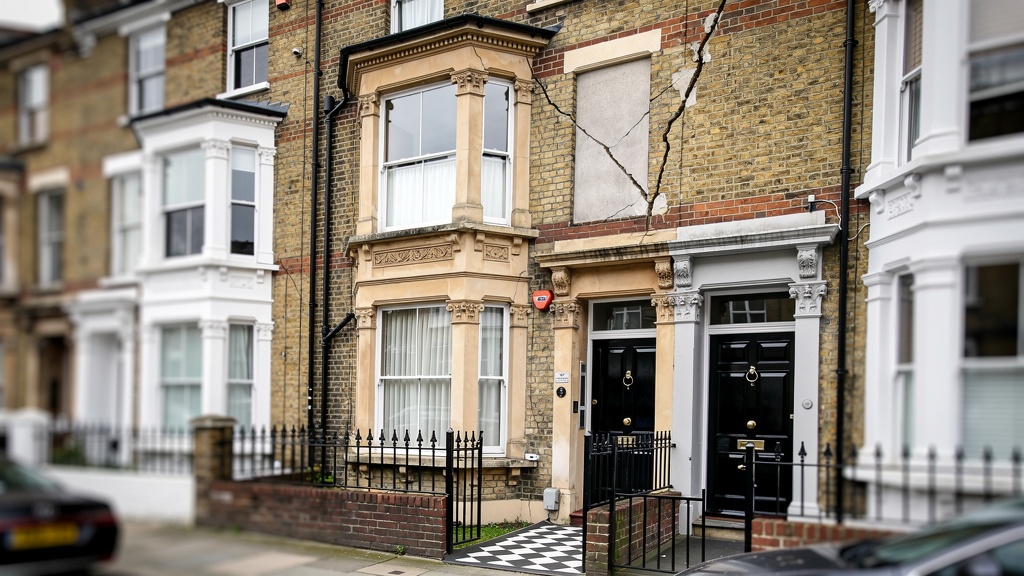
South London's housing stock is dominated by Victorian and Edwardian properties — most built between 1880 and 1914. They're beautiful, characterful homes. They're also, on average, well over a century old. And while they were built to last, a century of weathering, poor maintenance, botched repairs and changing use has taken its toll on many of them.
As building surveyors operating in Balham and the surrounding areas, we've inspected hundreds of these properties. Here are the ten defects we find most often — and what you need to know about each of them.
1. Cracking and Movement in Bay Fronts
Bay windows are a defining feature of Victorian terraces, but they're also one of the most common sources of structural concern. Most bays are built on their own shallow foundations, separate from the main building. Over time, these foundations can settle at a different rate to the main structure, causing cracks to appear at the junction between the bay and the main wall.
Most bay cracking is historic and stable — it's been there for decades and isn't getting worse. But in some cases, particularly near trees or on shrinkable clay soils, movement can be ongoing. A surveyor will assess the pattern, width and direction of cracks to determine whether they're benign or require further investigation.
Typical repair cost: £500–£5,000+ depending on severity
2. Penetrating Damp
Penetrating damp occurs when water finds its way through the external fabric of the building — through defective pointing, failed render, cracked chimney stacks, blocked gutters or faulty window seals. It's extremely common in South London's older properties and often invisible until you know what to look for.
Signs include tide marks on internal walls, staining, peeling paint and — in severe cases — damage to plaster and floor timbers. A good surveyor will use a moisture meter to measure damp levels in walls and identify the likely source.
Typical repair cost: £300–£3,000 depending on cause and extent
3. Rising Damp
Rising damp occurs when groundwater rises up through the walls from below, typically in properties where the damp-proof course (DPC) has failed or is absent. Older Victorian properties were often built without a DPC, or with a slate DPC that has since cracked or failed.
True rising damp (as opposed to condensation or penetrating damp, which are much more common) rarely rises above about 1 metre above floor level. It typically causes a characteristic tide mark pattern, salt deposits and damaged plaster at low level.
Typical repair cost: £1,000–£4,000 for a chemical DPC injection
4. Roof Defects
The roofs of Victorian and Edwardian properties are typically of traditional cut-roof construction, covered in plain clay tiles or slate. The tiles and slates themselves can last 100+ years, but the battens and felt beneath them have a shorter lifespan — typically 30–50 years.
Common roof defects include: slipped or missing tiles, failed flashings, blocked valley gutters, deteriorated hip and ridge mortar, and evidence of past leaks in the loft space. Our surveyors inspect the roof covering from ground level and from inside the loft wherever accessible.
Typical repair cost: £500–£15,000+ depending on whether patching or full re-roofing is needed
5. Chimney Defects
Most Victorian properties in Balham have multiple chimney stacks. These are exposed to the worst of the weather and are frequently in poor condition by the time we inspect them. Common issues include: spalled brickwork, deteriorated pointing, failed lead flashings, leaning or overhanging stacks, and ineffective flaunching (the cement cap around the chimney pots).
A defective chimney that penetrates the roof is a significant source of water ingress. We always look carefully at chimney condition and recommend further investigation where we have concerns.
Typical repair cost: £500–£4,000 per chimney stack
6. Subfloor Ventilation Issues
Victorian terraces typically have suspended timber ground floors — wooden floorboards laid on joists that sit above a void beneath. For this system to work, the void needs to be adequately ventilated through airbricks in the external walls. If those airbricks have been blocked (often by rising ground levels or over-enthusiastic decoration), the void becomes damp and the floor timbers start to rot.
Timber rot in suspended floors is more common than most buyers realise, and can be expensive to fix. We always check subfloor ventilation and inspect ground-floor timbers where access is available.
Typical repair cost: £1,500–£8,000+ depending on extent of rot
7. Flat Roof Defects
Many South London properties have had flat-roofed extensions added at some point — and flat roofs have a finite lifespan. A bitumen felt flat roof typically lasts 10–15 years; a GRP (fibreglass) roof can last 25+ years. By the time a property comes to market, the original flat roof may be well past its best.
Signs of a failing flat roof include blistering, cracking, ponding water, moss growth and evidence of leaks on the ceiling below. We always check flat roof areas carefully.
Typical repair cost: £500–£4,000 for replacement
8. Faulty or Outdated Electrics
We don't test electrical systems during a building survey — that's for a qualified electrician — but we do comment on visible evidence of the electrical installation's age and condition. In older properties, we frequently encounter rubber-insulated wiring (which should have been replaced decades ago), old-style consumer units without modern RCDs, and inadequate earthing.
An outdated electrical installation isn't necessarily dangerous, but it will need to be replaced, and that's a significant cost that buyers should factor in.
Typical upgrade cost: £2,000–£6,000 for a full rewire
9. Structural Alterations Without Building Regulations Consent
We see this constantly. An internal wall has been removed. A chimney breast has been taken out. A loft has been converted. And there's no building regulations certificate — because nobody applied for one at the time. This creates real problems for buyers, particularly when it comes to mortgage lending and future sale.
In most cases, a retrospective regularisation application can be made to the local authority. But it requires a structural engineer's assessment and can be costly.
Typical resolution cost: £1,500–£5,000
10. Poor Drainage and Blocked Gutters
It sounds trivial, but poorly maintained gutters and downpipes are the source of a huge amount of damp-related damage in South London properties. A blocked gutter overflows during rain, saturating the wall behind it. Over years, this causes significant penetrating damp, deterioration of wall ties and damage to internal finishes.
We always look at the condition of gutters and downpipes and flag any that appear blocked, leaking or inadequate.
Typical repair cost: £100–£600 for gutter clearance and repairs
The Bottom Line
This might all sound alarming. But please don't let it put you off buying in South London. Most of these defects are manageable. Many are expected in properties of this age. The important thing is to know about them before you buy — so you can either renegotiate the price, budget for the repairs, or walk away if the issues are too serious.
That's exactly what a building survey from Balham Surveyors gives you: the full picture, in plain English, before you're committed.
Absolutely — Victorian properties are some of the best homes to own. They're solidly built, full of character, and tend to hold their value well. The key is going in with your eyes open. A good building survey will tell you exactly what you're taking on so you can make an informed decision.
For most Victorian terraces in South London, we recommend a RICS Level 3 building survey (full structural survey). These properties are over 100 years old and invariably have age-related issues that benefit from the in-depth analysis a Level 3 survey provides. At minimum, go for a Level 2 — but don't settle for a basic condition report.
Yes — cost estimates for repair work are included in our Level 3 building surveys. These are indicative estimates based on our experience, not formal contractor quotes, but they give you a useful basis for budgeting and negotiating.
Subsidence is downward movement of the ground beneath a building, which causes the building's foundations to sink. It's relatively common in parts of South London where the subsoil is London Clay — which shrinks in dry summers and expands in wet weather. Properties near large trees are particularly at risk. A surveyor will look for signs of subsidence and recommend further investigation where appropriate.
At Balham Surveyors, we typically carry out inspections within 5 working days of instruction and deliver reports within 5–7 working days of the inspection. So from instruction to report, you're usually looking at around 2 weeks in total.