When I started out as a building surveyor, the main tools of the trade were a clipboard, a moisture meter, a torch and a good eye for detail. Those fundamentals haven't changed. But technology has given us some genuinely powerful new tools — and none more so than thermal imaging.
I'm James Hartley, a building surveyor at Balham Surveyors, and thermal imaging has become one of the most valuable tools in my kit. Let me explain how it works, what it can reveal, and when we use it.
What Is Thermal Imaging?
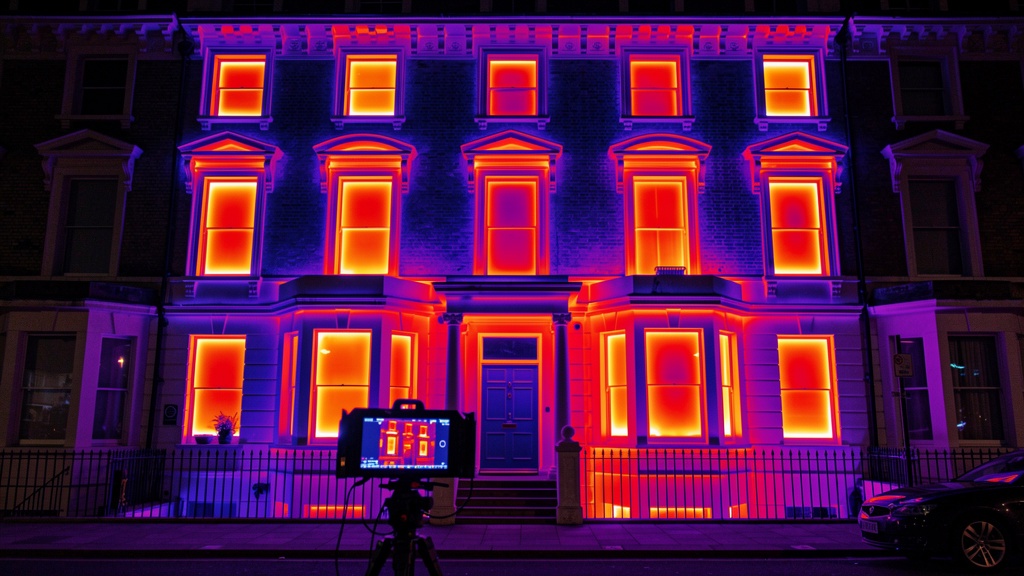
A thermal imaging camera (also called an infrared camera) doesn't capture visible light — it captures heat. Every surface emits infrared radiation proportional to its temperature. A thermal camera translates those temperature differences into a colour-coded image: warm surfaces appear red or yellow, cold surfaces appear blue or purple.
The result is a thermal "map" of the surfaces being inspected, which can reveal things that are completely invisible to the naked eye.
What Can Thermal Imaging Reveal in a Building Survey?
1. Moisture and Damp
Damp areas of a wall are cooler than dry areas, because water evaporating from the wall surface absorbs heat. A thermal camera picks up these temperature differences as distinct cool patches, even when there's no visible staining or mould. This is particularly useful for identifying:
- Penetrating damp behind dry-lined walls (where plasterboard has been fixed over the original wall, concealing any evidence of damp)
- Leaks from internal pipework before they become visible as ceiling or wall staining
- Areas of residual damp after repairs have been carried out
2. Missing or Inadequate Insulation
In an insulated building, heat loss should be uniform — the insulation prevents hot areas from forming at thermal bridges. Where insulation has been installed poorly, has settled or is missing entirely, the wall or roof will be noticeably cooler (in winter, when the building is heated) in those areas.
This is particularly relevant when assessing loft insulation — a poorly insulated loft will show a characteristic hot-roof pattern on thermal imaging that a well-insulated roof won't.
3. Structural Anomalies
The thermal properties of different materials vary significantly. Concrete, brick, timber, steel and air cavities all absorb and release heat at different rates. A thermal camera can sometimes identify:
- Timber frame elements within a masonry wall (useful when assessing altered or unusual construction)
- Voids in solid floors or walls (which appear as distinct thermal anomalies)
- Areas of different construction that may indicate past repairs or alterations
4. Underfloor Heating Problems
For properties with underfloor heating, thermal imaging is an excellent diagnostic tool. Leaks or blockages in the underfloor heating system appear as cold zones on the floor surface, making them easy to locate without invasive investigation.
5. Electrical Issues
Electrical components that are overloaded or failing generate excess heat. While building surveyors don't carry out electrical testing, a thermal camera can sometimes identify hotspots around distribution boards, sockets or switches that warrant investigation by a qualified electrician.
The Limitations of Thermal Imaging
Thermal imaging is a powerful tool, but it has important limitations that any good surveyor will be honest about.
For thermal imaging to work effectively, there needs to be a sufficient temperature differential between the inside and outside of the building — typically at least 10°C. In summer, when inside and outside temperatures are similar, thermal imaging is largely ineffective for detecting heat loss or structural anomalies.
Thermal imaging also can't "see through" surfaces — it only detects what's happening on the surface being imaged. And interpreting thermal images requires skill and experience: many thermal anomalies have innocent explanations (solar gain from sunlight hitting one part of a wall, for example) that an inexperienced operator might misidentify as defects.
At Balham Surveyors, we use thermal imaging as one tool among many — always interpreted alongside visual inspection, moisture meter readings and our knowledge of the property's construction and history.
When Do We Use Thermal Imaging at Balham Surveyors?
We use thermal imaging selectively — in situations where we believe it will add genuine value to the survey. Typical situations include:
- Level 3 building surveys on older properties where hidden damp is suspected
- Properties where dry-lining or cladding may be concealing underlying issues
- Properties with recent renovation work where we want to verify the quality of insulation installation
- Any property where visual inspection suggests the possibility of concealed moisture but we want to be more certain before raising it as a significant concern
A Case Study: The Hidden Leak
Last winter, I surveyed a 1930s semi-detached house in Balham for a buyer who was considering a Level 3 building survey. Visual inspection of the first-floor bedroom looked entirely clean — recently redecorated, no visible staining, no musty smell.
But the thermal camera picked up a distinct cool zone in the corner of the room, at ceiling height. Further investigation revealed a slow leak from the bathroom on the floor above — water had been tracking along a joist and soaking into the wall, causing hidden damage to the timber structure. It would have continued unseen for months until the ceiling eventually failed.
The buyer used our report to negotiate a £4,000 reduction in the purchase price — enough to cover the repair work. Without thermal imaging, we would never have found it.
We use thermal imaging selectively, in situations where we believe it adds genuine value. We don't charge extra for it — if we use it during your survey, it's included in the fee. Not all surveyors offer thermal imaging as part of their standard survey service; we consider it an important additional layer of inspection for certain property types and situations.
Thermal imaging can detect active moisture — areas where water is currently present and evaporating. It's less effective at detecting historical damp that has since dried out. It also depends on having a sufficient temperature differential between inside and outside. We always use moisture meters alongside thermal imaging to confirm our findings.
No — thermal imaging complements but does not replace traditional surveying methods. A thorough visual inspection, moisture meter readings, tapping for hollow plaster, and detailed examination of the building's history are all still essential. Thermal imaging gives us an additional layer of information that can confirm or challenge what visual inspection suggests.